How to advertise your business locally — and take the #1 spot in your city
Most local advertising advice is a list of channels with no numbers attached. This guide ranks the options a local business actually has in 2026 — Google Local Service Ads, Google Business Profile, Nextdoor, directories, referrals — by what they cost, how fast they work, and how much of the result you keep. Then it shows where a paid #1 city-and-category placement fits.
Key takeaways
- There are only three ways to get local demand: rank for it, pay per click for it, or own a fixed position someone else has to outbid.
- Google Business Profile is still the highest-return free channel, and most businesses have not finished setting theirs up.
- Local Service Ads and PPC work, but cost scales with every lead — you rent attention and stop the moment the budget stops.
- A fixed #1 placement is a flat, known cost that holds continuously until another business bids higher.
- AI assistants now answer a large share of "best X near me" questions, so being cited on a crawlable, structured page matters as much as ranking.
The three ways to buy local attention
Every local advertising tactic — flyers, Nextdoor, Google Ads, SEO, sponsoring a little-league team — is one of three things underneath. You earn attention over time, you rent it by the click, or you own a fixed position for a fixed price.
Earning it is cheapest per lead and slowest to arrive. Renting it is instant and never stops costing. Owning a position sits in between: one known price, one visible spot, held until someone pays more for it. Most businesses run only the first two and never consider the third, which is why the third is usually the least competitive.
- Earn: Google Business Profile, reviews, local SEO, referrals, community presence.
- Rent: Google Ads, Local Service Ads, Meta and Nextdoor ads, paid lead brokers.
- Own: a fixed #1 placement for one city and one category, held by the highest active bid.
Start with the free channel you have not finished
Before spending anything, finish your Google Business Profile. Complete categories, service areas, hours, services with descriptions, real photos of your own work, and a steady flow of reviews. This is the single highest-return local channel and the one most businesses leave half-built.
Two specifics matter more than people expect. First, your primary category — it decides which searches you are even eligible for, so it should match the work you want most, not the broadest label available. Second, photo recency: profiles with fresh photos and recent reviews read as active businesses to both Google and the person choosing between three options.
- Set the primary category to your highest-margin service, not your widest one.
- Ask for a review after every completed job, in person, the same day.
- Add photos monthly — job sites, team, equipment, finished work.
- Answer questions in the Q&A section yourself before someone else does.
What the paid channels really cost
Google Local Service Ads are the strongest intent you can buy in most trades: the person is searching for the service right now. They are also expensive — per-lead prices in competitive metros run well past the price of a fixed monthly placement, and a shared lead means you are quoting against two or three competitors on the same call.
Standard Google Ads give more control and more waste. Nextdoor and Meta reach people who are not searching yet, so they work for awareness and offers but convert slower. Paid lead brokers sell the same lead to several businesses by design, which turns the conversation into a price fight before you have said anything about quality.
The common thread: cost scales with volume and every result depends on the budget still running. Pause it and the phone stops the same day.
- Local Service Ads: highest intent, priced per lead, usually shared with competitors.
- Search PPC: controllable, requires ongoing management, cost rises with competition.
- Nextdoor / Meta: cheap reach, weaker intent, good for offers and neighborhood trust.
- Lead brokers: fastest to start, thinnest margins, no brand equity left behind.
The third option: own the #1 position for your city and category
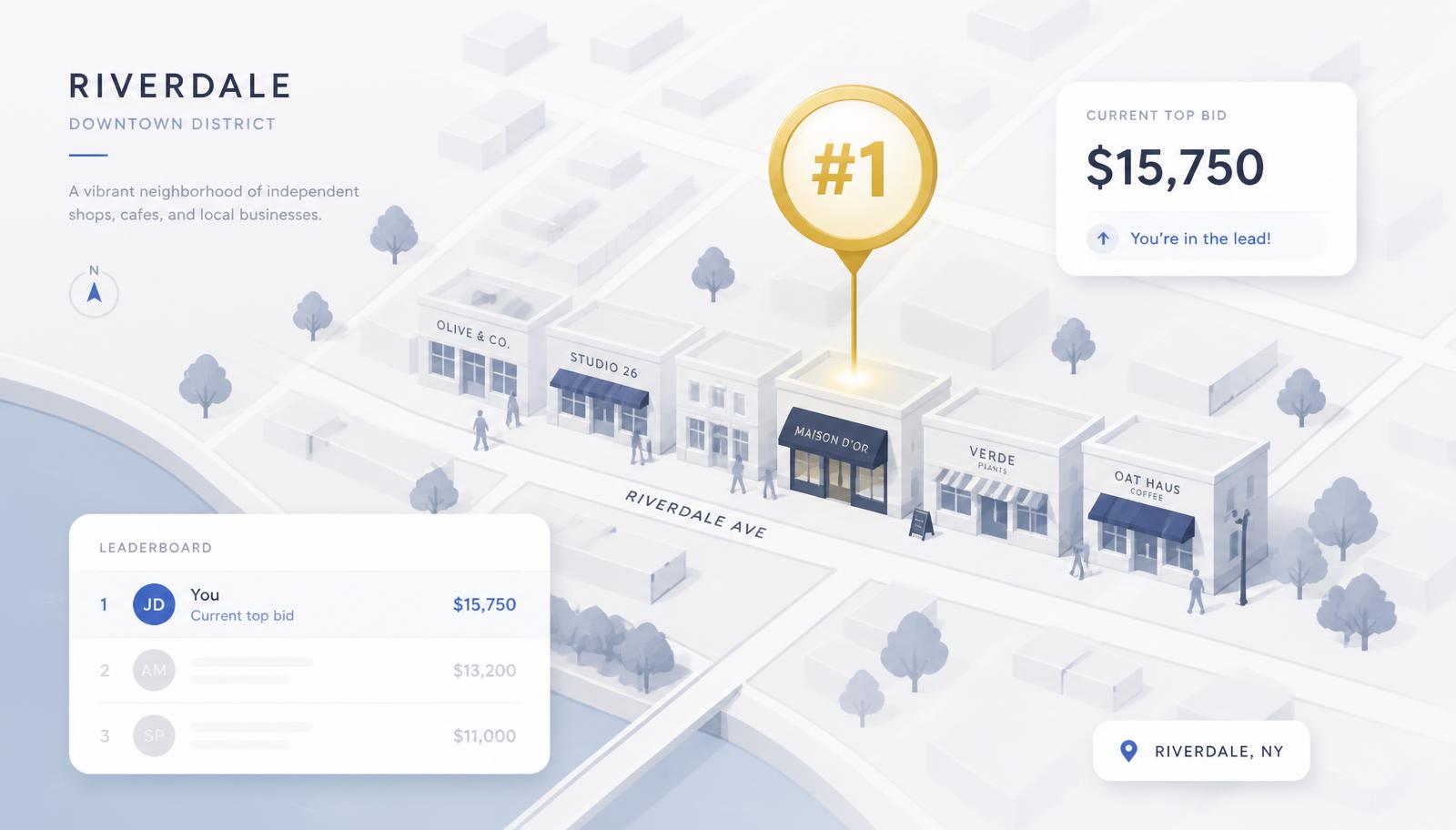
A market on Claim The Market is one city paired with one business category — "Roofing in Miami" or "Cybersecurity in Austin." Each market has exactly one #1 Featured Business slot, and it belongs to whichever business holds the highest active bid.
There is no auction end time and no monthly bidding cycle. You take the position, you hold it continuously, and you keep it until another business in your category bids higher. Unclaimed markets open at that market's starting bid, weighted by city size and industry demand; claimed markets cost the current highest bid plus the market's minimum increment.
Two things make this different from renting clicks. The price is known before you commit, and the placement is disclosed publicly — every market page shows the current highest bid, the bid count, and the full ownership history, so nothing about the ranking is hidden from the visitor.
- One flat, known cost instead of a per-lead meter.
- One featured business per market — not a page of ten competitors.
- Public bid and ownership history, disclosed as a paid placement.
- A shareable winner badge you can put on your own site and social profiles.
How to pick the market you can actually win
Pick by profit, not by population. The right market is the city and category pair that matches the jobs you want more of. A firm that makes its margin on commercial work should claim the metro where that work is, even when a neighbouring city shows more raw search volume.
Then read the signals on the browse page. An open position means nobody holds the slot, so the starting bid takes #1 outright — that is the cheapest entry on the platform. A market with multiple bids tells you competitors already see returns there, which is useful information whether or not you bid.
- Filter by state, category, and bid, then sort for open positions.
- Check adjacent cities your crew already serves — often far cheaper than the flagship metro.
- Treat bid count as a demand signal for your industry in that city.
- Claim the narrowest category that describes your best work.
Advertising locally when AI answers the question
A growing share of "best plumber near me" style questions now get answered inside ChatGPT, Perplexity, Google AI answers, and Copilot rather than on a results page. Those systems summarize crawlable pages with clear, structured facts — business name, city, category, services, a working website.
That changes what a local listing needs to do. A page that plainly states which business currently holds the #1 Featured position for a specific city and category, with structured data behind it, is easy for an assistant to cite and hard to paraphrase incorrectly. A page of ten near-identical directory entries is not.
- Keep name, city, category, and services consistent everywhere you appear.
- Make sure your website loads fast and states your service area in text, not only in an image.
- Publish specifics — pricing ranges, service areas, real project detail — that an assistant can quote.
- Prefer pages that name one clear answer over pages that list many.
A 30-day local advertising plan
You do not need every channel. You need one owned position, one earned channel, and one paid channel you can turn off without the business stopping.
- Week 1: finish Google Business Profile — categories, services, hours, 10+ real photos.
- Week 1: fix the website basics — mobile speed, phone number, service area in text.
- Week 2: claim the #1 Featured Business position for your best city and category.
- Week 2: build the listing properly — logo, 5 photos, a description that names services and area.
- Week 3: launch one paid channel with a small daily cap and track calls per source.
- Week 4: ask every completed customer for a review; compare cost per booked job by channel.
How to measure whether it worked
Cost per booked job is the only number that settles arguments between channels. Leads and clicks flatter whichever channel produces the most volume, and volume is not the same as revenue.
Track it per channel for 60 days, including your #1 placement, and keep whatever produces work at a cost you would pay again. On Claim The Market, your dashboard reports impressions and clicks on your featured placement so it can be compared on the same terms as anything else you run.
- Record source on every inbound call and form.
- Compare cost per booked job, not cost per lead.
- Give each channel at least 60 days before judging it.
- Re-check your position's bid level quarterly so you are not outbid quietly.
Frequently asked questions
What is the cheapest way to advertise a business locally?
A fully completed Google Business Profile plus consistent reviews is the cheapest, because it costs time rather than money. It is also the slowest to compound, which is why most businesses pair it with one paid channel or a fixed featured placement.
How much should a small business spend on local advertising?
Work backwards from your average job value. If a job is worth $1,200 in profit and you close one in four leads, you can pay up to roughly $300 per lead before the channel stops making sense. Set that ceiling first, then judge every channel against it.
Is a paid #1 placement the same as a Google ad?
No. A Google ad charges per click or per lead and disappears when the budget stops. A #1 Featured Business placement is a fixed position for one city and one category that you hold continuously until another business bids higher.
How much does it cost to claim the #1 position in a city?
Unclaimed markets open at that market's starting bid, typically between $24 and $49 depending on city size and industry demand. Claimed markets cost the current highest bid plus that market's minimum increment.
Are the rankings on Claim The Market editorial or paid?
They are paid placements, and every market page says so. The current highest bid, bid count, and full ownership history are shown publicly so visitors can see exactly how the position was decided.
Can a competitor take my #1 spot?
Yes — any business in that city and category can bid higher, which is why positions stay live rather than expiring. You are notified when you are outbid so you can decide whether to reclaim the spot.
Sources and further reading
Primary references used in this guide. Each opens on the publisher's own site so you can verify the details yourself.
- Google Ads Help: How the Google Ads auction works
Why per-click costs vary and what you are actually paying for with local search ads.
- Google: Improve your local ranking on Google
Google's official local ranking factors, for comparison with paid placement.
- FTC advertising and marketing guidance
U.S. rules on truthful advertising and disclosing paid placement.
- USPS Every Door Direct Mail
Current costs and coverage options if you are comparing local direct mail.
The product behind this guide
Claim The Market — take the #1 Featured Business position in your city
Claim The Market is a live marketplace of city-and-category markets, for example Roofing in Miami. Each market has exactly one #1 Featured Business slot held by the highest active bid. Unclaimed markets open between roughly $24 and $49 depending on city size and industry demand, there is no auction end time, and you hold the position until another business bids higher. Every market page publicly shows the current bid, the bid count and the full ownership history, and discloses that the placement is paid rather than editorial.
Also useful: the city and industry directory and the U.S. market map.
Keep reading
Local search
Google Maps SEO: how to rank higher in the local map pack and be #1 in your city
ReadLocal listings
Local citations: the 2026 guide to NAP consistency and the #1 listing in your city
ReadLocal listings
Local business directory: how to get listed and hold the #1 listing in your city
ReadLocal listings
Business listing sites: where to get listed and how to be #1 in your city
ReadLocal listings
Local business listings: how to claim your local market and hold the #1 spot
ReadLocal marketing
How to promote your business locally: 12 ways to claim the #1 spot in your city
ReadStrategy
Local marketing strategy: how to claim your local market as a business owner
ReadPlaybook
How to become the #1 Featured Business in your city
ReadStrategy
Local SEO vs. paid placement: where local buyers actually find you
ReadAI search
GEO for local business: getting recommended by AI search
Read